
Simulate the operation—not just the space.
SpatialSim connects demand, people, equipment, holding, movement, service capacity, and operating assumptions inside one interactive model so teams can test how a facility may perform before decisions become physical.
One platform. Multiple operational systems.
Each simulation can be evaluated independently, but the greatest insight comes from understanding how the systems influence one another.
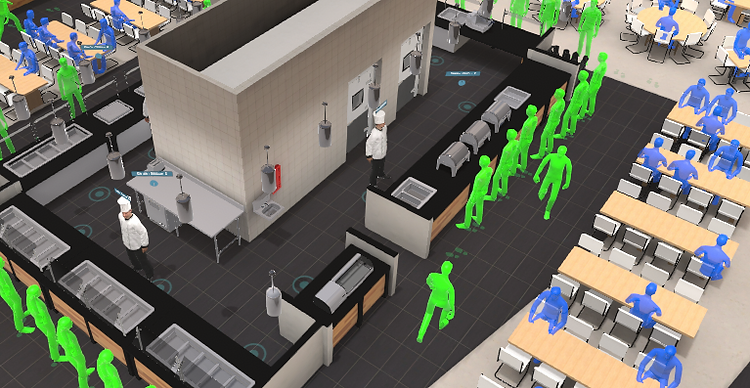
Guest Flow & Queues
Model continuous arrivals, scheduled waves, queue buildup, wait time, service capacity, congestion, and movement through the operation.
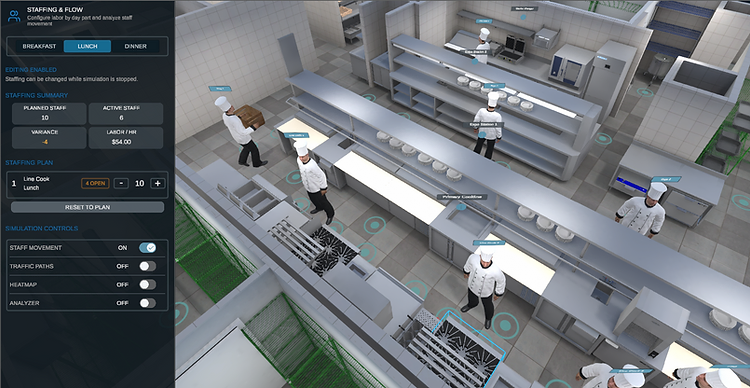
Explore simulationStaffing & Labor
Compare staffing levels, roles, station assignments, labor cost, employee movement, utilization, and workload across dayparts and demand conditions.
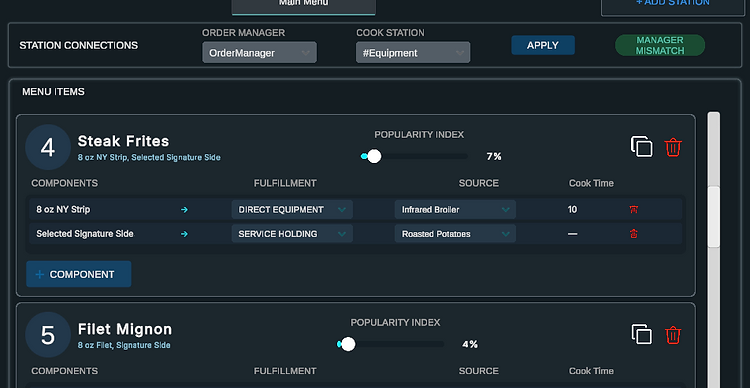
Explore simulationMenu Demand
Use menu mix, selection behavior, preparation methods, cook times, and demand spikes to translate guest activity into production requirements.
Explore simulationHolding & Replenishment
Model service holding, intermediary or batch holding, consumption, trigger points, replenishment requests, batch production, and service availability.
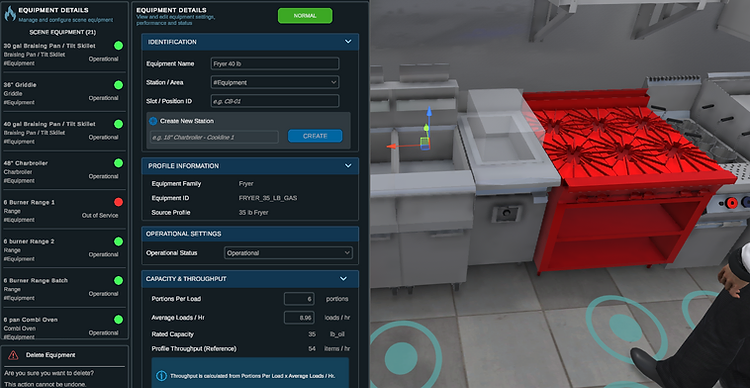
Explore simulationEquipment Capacity
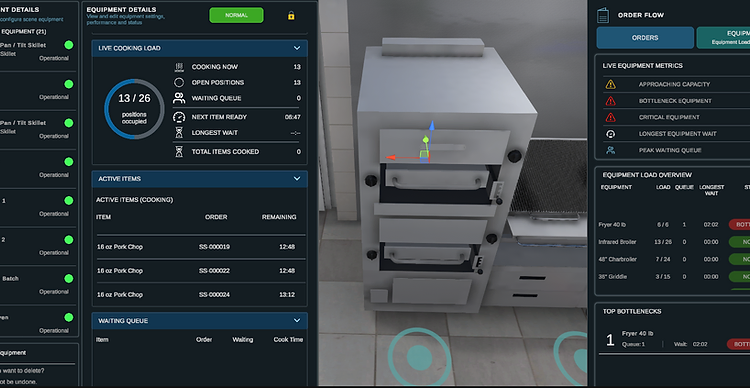
Connect equipment families, cook times, batch sizes, throughput, utilization, and downtime conditions to the demand that the operation must serve.
Explore simulationThroughput & Service Capacity
Evaluate meals per hour, peak-period performance, station utilization, queue behavior, service rate, and the constraints that determine total system capacity.
Explore simulationMovement & Workflow
Analyze employee travel paths, guest circulation, cross-traffic, touchpoints, walking distance, congestion, and the operational relationships between stations.
Explore simulationUnderstand what happens when demand actually arrives.
Model continuous arrivals, scheduled waves, queue buildup, wait time, service capacity, congestion, and movement through the operation.
What can be tested
- Guests per minute
- Scheduled group releases
- Multiple queue locations
- Peak-demand surges
- Queue capacity
- Service-rate changes
Questions it can help answer
- How many guests can the operation serve per hour?
- Where will queues form?
- What happens when large groups arrive together?
- Which service point becomes the bottleneck?

Test labor against real operating demand.
Compare staffing levels, roles, station assignments, labor cost, employee movement, utilization, and workload across dayparts and demand conditions.
What can be tested
- Staff count by role
- Daypart assignments
- Station coverage
- Labor cost per hour
- Employee utilization
- Route and movement patterns
Questions it can help answer
- How many employees are required at peak?
- Where is labor underutilized?
- Does an additional employee improve throughput?
- Which stations create workload imbalance?

Connect what guests order to what the kitchen must produce.
Use menu mix, selection behavior, preparation methods, cook times, and demand spikes to translate guest activity into production requirements.
What can be tested
- Menu popularity
- Item selection mix
- Component demand
- Cook methods
- Peak order spikes
- Multiple service stations
Questions it can help answer
- Which menu items drive equipment demand?
- How does menu mix change production load?
- What happens when demand shifts between stations?
- Which components constrain service capacity?

See depletion and replenishment before product runs out.
Model service holding, intermediary or batch holding, consumption, trigger points, replenishment requests, batch production, and service availability.
What can be tested
- Service holding capacity
- Batch holding capacity
- Replenishment triggers
- Batch quantities
- Cook replenishment time
- Product availability
Questions it can help answer
- Is holding capacity sufficient for demand?
- How often will product need replenishment?
- Can batch holding protect the service line?
- When does the cookline need to start another batch?

Evaluate equipment as part of the operating system.
Connect equipment families, cook times, batch sizes, throughput, utilization, and downtime conditions to the demand that the operation must serve.
What can be tested
- Equipment throughput
- Cook and cycle times
- Batch size
- Utilization
- Alternative equipment
- Out-of-service conditions
Questions it can help answer
- Is the proposed equipment package large enough?
- Where is excess capacity being purchased?
- What happens when equipment goes out of service?
- Which equipment choice improves system balance?

Measure the capacity of the complete operation.
Evaluate meals per hour, peak-period performance, station utilization, queue behavior, service rate, and the constraints that determine total system capacity.
What can be tested
- Meals or guests per hour
- Peak 15-minute demand
- Station utilization
- Service rate
- Capacity thresholds
- Scenario-to-scenario variance
Questions it can help answer
- What is the realistic hourly capacity?
- Which station limits total throughput?
- Can the operation absorb peak demand?
- What improves capacity without adding unnecessary cost?

Measure how people and work move through the space.
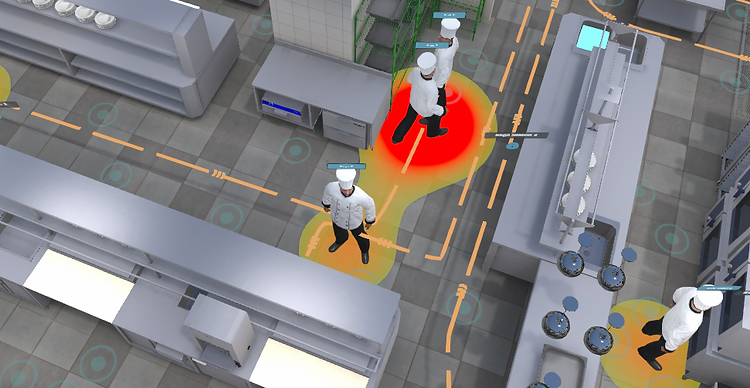
Analyze employee travel paths, guest circulation, cross-traffic, touchpoints, walking distance, congestion, and the operational relationships between stations.
What can be tested
- Staff travel distance
- Guest circulation
- Cross-traffic
- Touchpoints
- Longest routes
- Congestion areas
Questions it can help answer
- Where are employees walking unnecessarily?
- Which paths cross or conflict?
- Does the layout support the intended workflow?
- Where are the highest movement costs?

Operational systems do not operate independently.
A change in demand can influence holding, equipment production, staff workload, queues, and throughput. SpatialSim is designed to connect those relationships instead of treating them as isolated calculations.
Simulation is not about producing one answer.
Compare alternative layouts, staffing models, equipment packages, holding strategies, arrival patterns, and operating assumptions using a consistent set of performance measures.
Discuss a scenarioCurrent Design
- Throughput
- 148/hr
- Peak Queue
- 8.4m
Revised Cookline
- Throughput
- 172/hr
- Peak Queue
- 6.1m
Optimized Operation
- Throughput
- 186/hr
- Peak Queue
- 4.8m
Bring the operational question. Build the model around it.
How many guests can this facility realistically serve per hour?
How many employees are needed during peak demand?
Where will operational bottlenecks occur?
Is the proposed equipment package large enough?
Is holding capacity sufficient for the menu mix?
How often will food need to be replenished?
Will scheduled groups overwhelm the service line?
How far are employees walking during service?
What happens if equipment goes out of service?
Would an alternative layout improve throughput?
Does additional labor actually improve capacity?
Where is excess equipment capacity being purchased?
Built for operations where flow, capacity, and timing matter.
SpatialSim can be configured around many different foodservice environments, service styles, demand patterns, and operating constraints.
Add operational testing to the existing design workflow.
Existing Design
Revit · CAD · SketchUp · BIM
Operational Inputs
Menu · staffing · equipment · arrivals
Simulation
Run realistic and peak conditions
Analysis
Identify constraints and alternatives
Decision Support
Compare performance before implementation
Common questions about operational simulation.
SpatialSim complements the existing design and planning process by adding a measurable operational testing layer.
Foodservice operational simulation models how demand, staffing, equipment, queues, holding, movement, and service capacity interact over time. It allows teams to test operating conditions before committing to physical changes.
Have an operational question? Test it before making the investment.
Bring us a design, renovation, operating challenge, or proposed concept. We can help determine what should be modeled, measured, and compared.